


Page 9 - Demo
P. 9
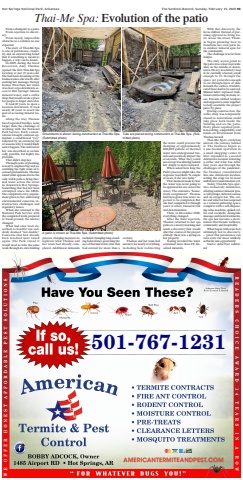
Hot Springs National Park, Arkansas The Sentinel-Record, Sunday, February 15, 2026 9C 472749-1 394926-1 READERS CHOICE AWARD 14 YEARS IN A ROW WE OFFER HONEST AFFORDABLE PEST SOLUTIONSBOBBY ADCOCK, Owner1485 Airport RD %u2022 Hot Springs, AR%u2022 TERMITE CONTRACTS%u2022 FIRE ANT CONTROL %u2022 RODENT CONTROL%u2022 MOISTURE CONTROL %u2022 PRE-TREATS %u2022 CLEARANCE LETTERS %u2022 MOSQUITO TREATMENTSArkansas State Plant Board Licensed & Bonded Have You Seen These?If so, call us! 501-767-1231AMERICANTERMITEANDPEST.COMThai-Me Spa: Evolution of the patioFrom a dumpster to a patio.From rejection to discovery.From nearly impossible obstacles to a solution no one expected.The story of Thai-Me Spa is one of persistence, creativity and an unwavering belief that if something is meant to happen, a way can be found.In 2009, during the Great Recession, Amy Thomas opened the first Thai-Me Spa location at just 21 years old. She had been dreaming of the business since she was 18, after earning her massage therapy license. Even then, her vision was clear: a spa downtown, access to Hot Springs%u2019 famous mineral water, and a coffee shop that would create a place for people to linger and relax.It took 10 years to open a location downtown. It took nearly 20 years to reach the goal of accessing mineral water.Along the way, Thomas faced repeated hurdles, none larger than the challenge of working with the National Park Service. Early conversations brought cautious optimism: a conditional %u201cyes,%u201d followed by an extensive list of reasons why it would likely never happen. The task before her was described as technically possible, but highly improbable.That didn%u2019t stop her.Through years of planning, research, engineering and assembling the right team of licensed professionals, Thomas found what appeared to be the only viable path to bring thermal water across the street in downtown Hot Springs. Something that had not been attempted since the 1800s. She completed every requirement given to her, addressing environmental concerns, infrastructure challenges and regulatory issues.When she returned to the National Park Service with the completed work, prepared to break ground, the answer changed.What had once been described as feasible was suddenly deemed %u201cnot doable.%u201d Concerns that had already been resolved were raised again. The Park stated it would need to redo the same work through its own bidding process, charging taxpayers to replicate what Thomas and her team had already completed. Additional demands included changing long-standing federal laws governing the use of thermal water, laws that had existed for more than a century.Thomas and her team had answers for nearly everything, including how redirecting the water could prevent the dumping of approximately 800,000 gallons of thermal water into underground tunnels and positively impact the ecosystem. What they could not accept was altering federal law simply to move forward.When asked how long the Park%u2019s process might take, the response was blunt: %u201cA couple of years, if she was lucky.%u201dThat moment made it clear the water was never going to be approved for use across the street. The extensive %u201chomework assignment%u201d Thomas had been given was never expected to be completed. But she had completed it through years of effort, financial risk and determination.Then, in December 2020, everything changed.After the final rejection, Thomas returned to her spa patio on a snowy morning and made a discovery that would alter the course of the project entirely: there was a spring on her property.Testing revealed the water contained more than 235 dissolved minerals.With that discovery, the focus shifted. Instead of pursuing approval to bring water across the street, Thomas began planning how to transform her own patio into outdoor mineral spas for the community.The challenge was far from simple.The only access point to the patio was a four-foot-wide alley in the middle of downtown. Heavy machinery had to be carefully selected, small enough to fit through the space yet powerful enough to cut through layers of slate beneath the surface. Prefabricated bases had to be sourced. Manual labor replaced traditional contracting in many areas. Friends, skilled workers and supporters came together to help assemble the project piece by piece.During construction, the coffee shop was temporarily closed so renovations could take place both inside the building and on the patio. Every phase required problem-solving, adaptability and hands-on involvement from Thomas herself.Thai-Me Spa%u2019s evolution mirrors the journey behind it. The business began as a one-woman operation in a small shopping center. It later expanded to a second downtown location featuring a coffee and wine bar. After four years and through the challenges of the pandemic, the business consolidated into one downtown location, setting the stage for its most ambitious transformation yet.Today, Thai-Me Spa operates exclusively downtown, offering outdoor mineral spas, a cold plunge, infrared saunas and an oxygen bar. The coffee and wine bar has reopened as a relaxed gathering space, complete with a self-dispensing wine machine, spiked coffee and cocktails. Alongside massage and facial treatments, the spa has become a destination that blends wellness, community and hospitality.What began with rejection ultimately led to discovery. %u2026 proof that persistence can turn even the most unlikely setbacks into opportunity.Source: Advertiser submittedTubs are placed during construction at Thai-Me Spa. (Submitted photo)Groundwork is shown during construction at Thai-Me Spa. (Submitted photo)A patio is shown at Thai-Me Spa. (Submitted photo)


